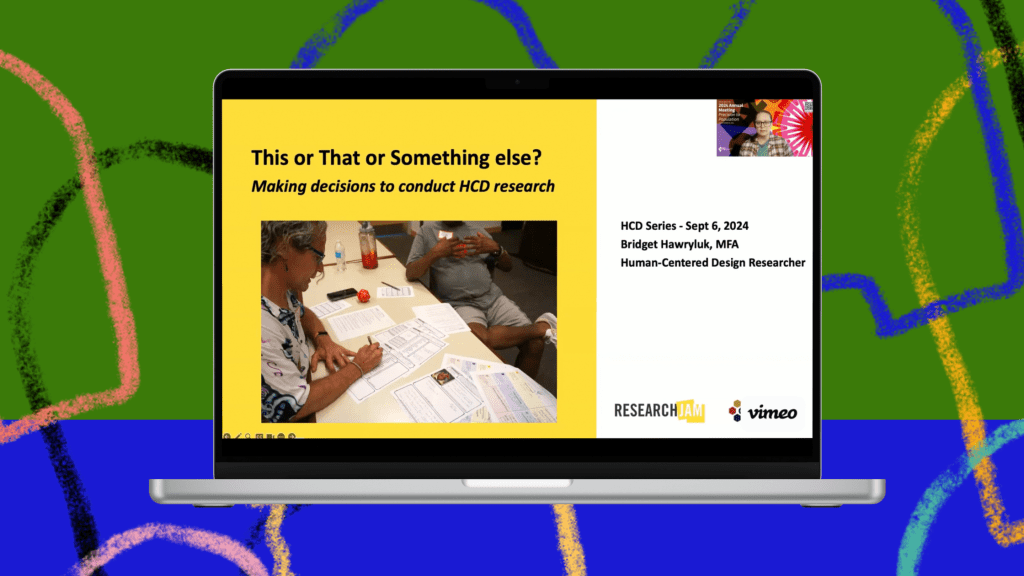
Human-Centered design. We get it. It’s good. How do we do it? This is what we are exploring in our 2024-25 online Human-Centered Design for Health Seminar Series. Bridget Hawryluk, Human-Centered Design Researcher at Research Jam, kicked off the series last September with an overview of HCD methods and how to choose ones that are right for your research project. Key takeaways:
- Embrace the iterative nature of human-centered design and become comfortable with ambiguity.
- Consider the following when thinking about what method to choose,
- Population – are group or individual methods more appropriate for your population/research question? Is it better to separate and mix different stakeholder or participant groups?
- Research Phase – are you exploring, creating, or testing?
- Funds/Timeline/Setting– what methods work best given your funds, timeline, and research setting?
- Explore using unconventional activities to encourage participants to ideate, such as:
- Alien Artifact – Ask participants to imagine that an alien spacecraft has come to earth with the answer to the research problem or challenge inside their spacecraft. Then, have them draw or describe this alien artifact. Emphasize that it doesn’t need to be real and to forget about any constraints.
- Random Image Generator – Share a set of random images with participants and ask them each to select one that illustrates something related to your research. Use this as a discussion tool for participants to explain their choices and how the image relates to the research or challenge. For example, during the session, Bridget asked us each to select an image that illustrates the value of using human-centered design in the Midwest. We then shared which one we picked and why.
- Worst Possible Idea aka “Broccoli butter” – Ask participants to come up with the “worst possible” solution or idea that addresses the research problem. Then follow up with “keep, toss, improve” aka “Rose Thorn bud” by asking what are the good and bad things about the idea.
Incorporating these types of activities encourage “out of the box” thinking and can lead to rich insights that may not emerge through more traditional research methods. As Bridget says, “in the explanation is really what is key there”. Catch the full recording for more.
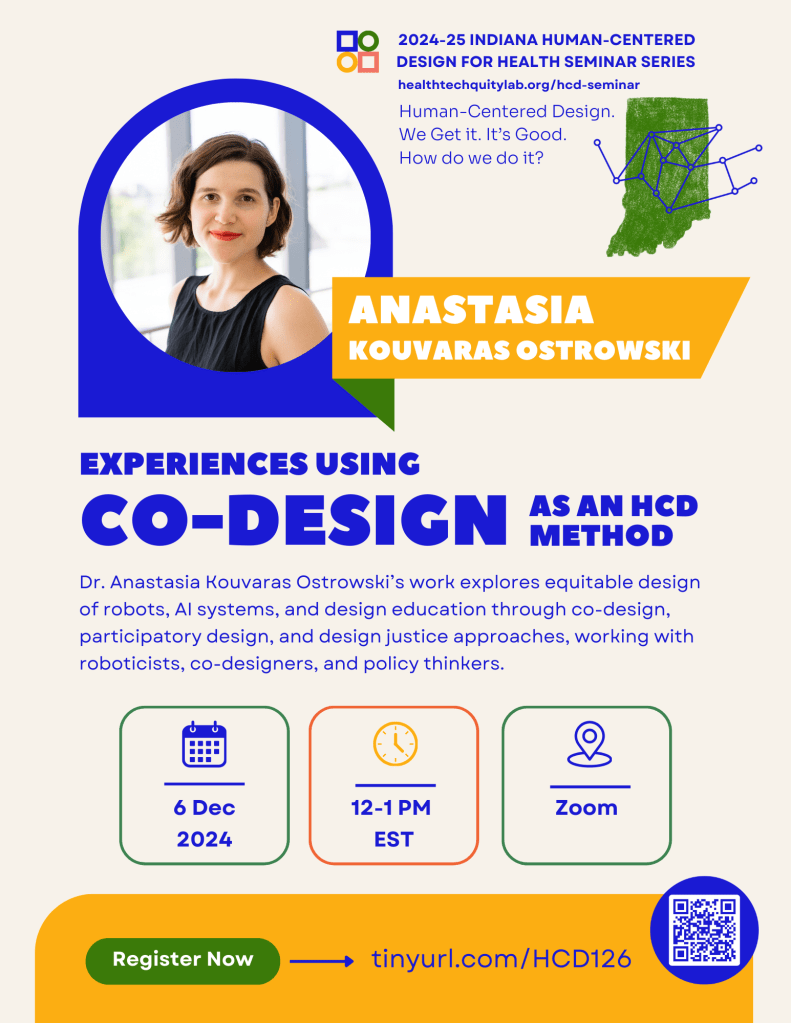
Next up in our series we’ll hear from Anastasia Kouvaras Ostrowski, Assistant Professor in in User Experience Design at Purdue University on Friday, December 6th from 12-1pm EST. Anastasia will talk about co-design guidelines and best practices through her experiences using co-design as an HCD method in her research.
 Health TechQuity Lab