Syringe exchange programs (SEP) lead to substance use recovery, decrease diseases, save lives, and save money. Despite more than 35 years of scientific evidence to support this claim, these programs are under threat here in Indiana with the SEP legislation set to expire on July 1, 2026.
While SEPs are perhaps most thought of as distributing clean syringes and naloxone to people who use drugs, they are much more. SEPs not only provide people with these life-saving supplies, but also access to support and care services – keeping communities clean and safe for everyone.
Debunking the Misconception
One misconception about syringe distribution is that it contributes to illicit substance use. The research says otherwise. Sharing of drug injection equipment contributes to the spread of infectious diseases like HIV and Hepatitis C (HCV). Not distributing clean syringes does not stop people from using a substance – it simply means that they will potentially use a used syringe to do so, increasing the likelihood of transmission.
SEPs have resulted in reductions in HIV transmission (up to 60% in the U.S.), as well as HCV.
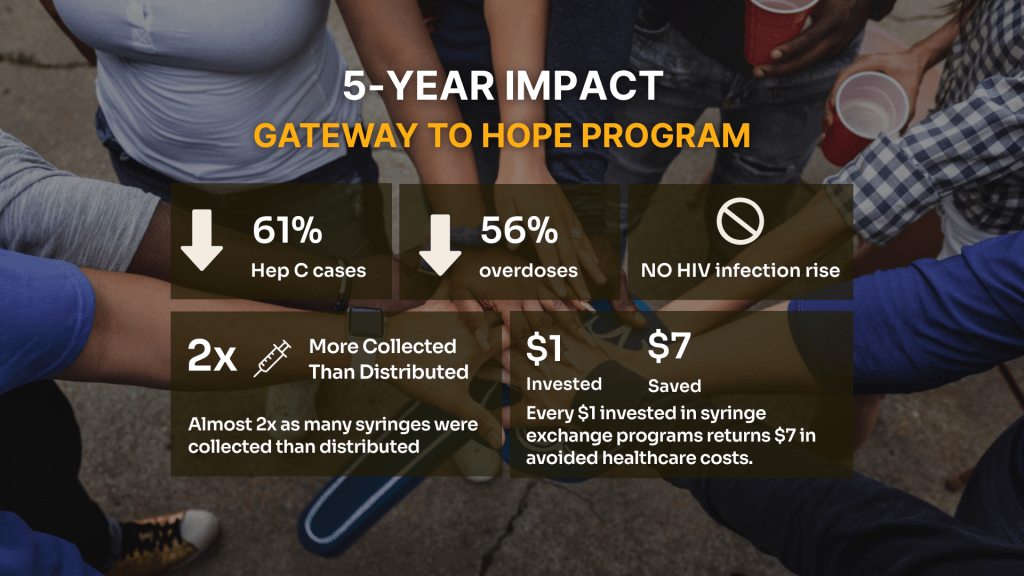
In addition, data from the CDC reports that syringe exchange participants are 5x more likely to enter substance use treatment. The evidence also shows that when a community has an SEP and broad access to naloxone, there is a lower population-based rate of substance use disorder overall over time. Finally, here in Indiana, it is estimated that every $1 invested in SEPs saves $7 in avoided healthcare costs.
Gate to Hope Program
In our local community, the Tippecanoe County Syringe Service Program, also known as Gateway to Hope, was started at a time of rising HCV transmission, which is often the lead-in to higher rates of HIV. The program collected nearly twice as many syringes than they distributed (no taxpayer dollars are ever used to purchase syringes). In just 5 years, the county had no rise in HIV infection, 61% reduction in HCV cases, and 56% reduction in overdose deaths. The impact is clear: fewer overdoses, fewer infections, a safer community.
Act Now!
What you can do is
Contact legislators to renew the expiring syringe exchange law in Indiana HERE (protectsep.org)
Learn more from these resources:
Syringe Exchanges Does and Doesn’t [link]
SEP Fact Sheet [link]
Gateway to Hope 5 Years of Impact [link]
References:
Broz, D., Carnes, N., Chapin-Bardales, J., Des Jarlais, D. C., Handanagic, S., Jones, C. M., McClung, R. P., & Asher, A. K. (2021). Syringe Services Programs’ Role in Ending the HIV Epidemic in the U.S.: Why We Cannot Do It Without Them. American journal of preventive medicine, 61(5 Suppl 1), S118–S129. https://doi.org/10.1016/j.amepre.2021.05.044
Des Jarlais, D. C., Feelemyer, J., McKnight, C., Knudtson, K., & Glick, S. N. (2021). Is your syringe services program cost-saving to society? A methodological case study. Harm reduction journal, 18(1), 126. https://doi.org/10.1186/s12954-021-00575-4
 Health TechQuity Lab